
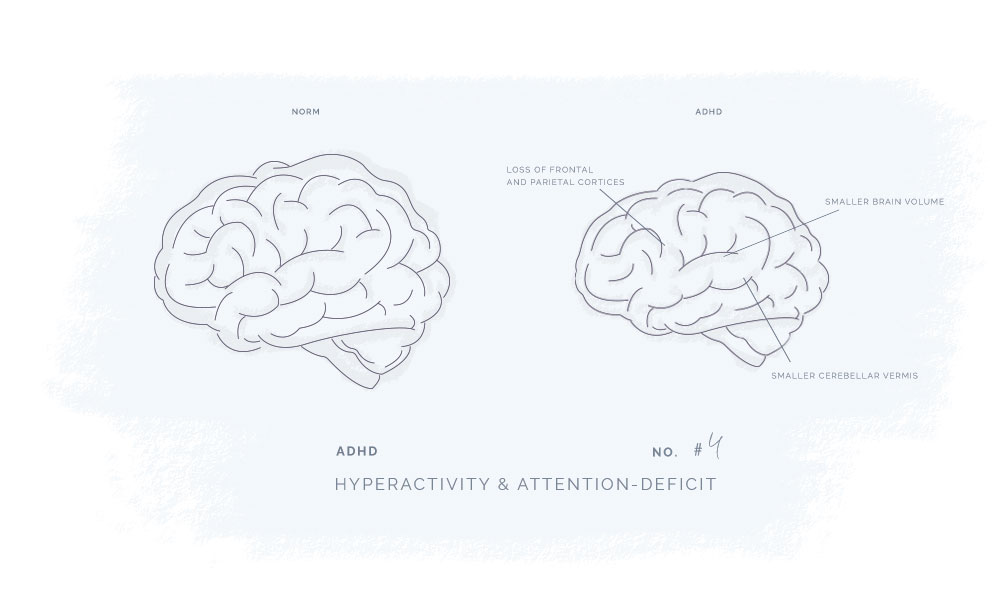
ADHD
Behavioral, Neurodevelopmental, Psychiatric
What is ADHD
Adult attention-deficit/hyperactivity disorder (ADHD) is a mental health disorder that leads to various problems like shorter attention span, hyperactivity, and impulse behavior.
Symptoms
The symptoms of ADHD in adults may not be the same as in children because the symptoms can change over time as the disorder develops. For example, hyperactivity in a child can decrease and be replaced with impulsiveness and restlessness in adulthood.
Regardless of the manifestation of symptoms, the disorder can have a great impact on all aspects of a person’s life as it may lead to poor school and work performance, lower self-esteem, and a range of other individual challenges.
Cause
The exact cause of ADHD is not yet known, however, current research proposes that three factors may be involved in the development of ADHD:
- Genetics/hereditary
Studies indicate that genes may play a role in the development of ADHD - Environment
External factors in the environment such as exposure to lead as a child may increase the risk of developing ADHD - Complications during development
If complications with the development of the nervous system in the fetus occur during pregnancy, it may increase the risk of ADHD
ADHD Symptoms
Differs from childhood to adulthood. Most commonly hyperactivity, impulsiveness, and restlessness,.
Therapeutic Potential
Preclinical data suggests CBD and THC among other cannabinoids may be therapeutic for ADHD.
Application options
Depending on your needs, the optimal type of application may vary. Find more information on our application options.
The connection between Cannabinoids & ADHD
Studies find that CBD and THC may have great therapeutic potential and may be used to help treat ADHD. CBD and THC are well-known cannabinoids, however, they do not have the same psychoactive effects. THC is psychoactive while CBD does not possess psychoactive effects. According to WHO guidelines, the cannabidiol CBD is generally well tolerated with a good safety profile.
The cannabinoids CBD and THC are proposed to have therapeutic properties for ADHD as there is a significant overlap between ADHD and other mental disorders such as anxiety, PTSD, OCD, and disorders within the autism spectrum where clinical data suggests the potential benefits of cannabinoids.
In addition, this study shows that there is a connection between a higher dose intake of medical cannabis components like phytocannabinoids and the reduction of ADHD medication. Furthermore, it was observed that there is a link between a high dosage of CBN and a lower ASRS score.
Another study suggests that adults with ADHD may experience a reduction of symptoms and no cognitive impairment when taking cannabinoids.
Literature Discussion
The literature discussion is an overview of the published results from scientific studies investigating if and how cannabinoids can be beneficial in the treatment of ADHD. The overview will be updated regularly to ensure the newest and most accurate information.
Cannabinoid may be able to supplement or replace current amphetamine treatment
Attention deficit hyperactivity disorder (ADHD) can be often treated by stimulants known as amphetamines.
Increased monoamine neurotransmission in brain regions such as the Abiotic stress (NAC) and medial prefrontal cortex (mPFC) brought on by amphetamine, is the cause for the drug´s behavioral effects.
In a rat study, it was discovered that CB1 activation is required for the therapeutic effect of amphetamines.
This offers the chance that current amphetamine treatment may be supplemented or replaced by the treatment of ADHD with cannabinoids.
Pros and cons of cannabinoid use in ADHD treatment
It was shown that ADHD is a heritable disorder.
A genetics study showed that small variations/mutations (single nucleotide polymorphisms) in the CB1 gene (CNR1) are tightly connected to ADHD
Similar to OCD, there is a connection between cannabis use and the incidence of ADHD.
The prevailing opinion existed that the use of cannabis may precipitate ADHD. An alternative opinion is arising that self-medication with cannabis may inhibit symptoms in people that tend to develop psychiatric disorders like ADHD.
More research is needed to identify whether cannabinoids impact ADHD positively or negatively or potentially do both.
Clinical Trials
Clinical trials are research studies that examine new treatments and evaluate their effects on human health outcomes.
Potential link between use of cannabinoids and less risk of being diagnosed with ADHD
The current study aimed to assess the link between ADHD subtypes and cannabis use (2811 people were included in a survey). It was found that people who did not use cannabis had a higher chance to be diagnosed with ADHD, proposing that cannabinoids may have therapeutic potential.
Significant improvement in hyperactivitu with cannabinoid medication
A pilot randomized placebo-controlled experimental study included 30 patients with ADHD to investigate the effect of the cannabinoid medication, Sativex Oromucosal Spray. Although no significant difference was seen in the cognitive performance between study participants treated with cannabinoid medication and the placebo reference group, a significant improvement was found in hyperactivity/impulsivity upon treatment
Omega-3 fatty acids plays a role in behavioral symptoms of ADHD.
In a meta-study of clinical trials, it was shown that behavioral symptoms of ADHD were slightly but significantly reduced by food supplementation with omega-3 fatty acids (especially EPA).
Cannabinoids & Receptors
Below you find the plant cannabinoids, cannabinoid receptors, and endocannabinoids that are associated with the potential therapy.
CBD
Cannabidiol (CBD) is a dominant cannabinoid in hemp. CBD does not possess psychoactive effects and does not make people high. CBD has been demonstrated to have potential as an alternative for several health-related conditions, including anxiety, pain, depression, among others.
THC
Tetrahydrocannabinol (THC) is a cannabinoid found in the cannabis plant. THC possesses psychoactive properties.
CB2
Cannabinoid receptors are located on the surface of cells in your body and they “listen” to conditions outside the cell. CB2 receptors are key players in the ECS. CB2 receptors are more abundant outside the nervous system, including cells of the immune system.
If you have any further information relevant to the connection between ADHD and cannabinoids or find any of the information inaccurate, outdated or incomplete please contact us here
References
- https://www.mayoclinic.org/diseases-conditions/adhd/symptoms-causes/syc-20350889
- https://ghmedical.com/endocannabinoid-system/diseases/adhd
- Aviram, J., Meiri, D. (2020) Cannabinoid and Terpenoid Doses are Associated with Adult ADHD Status of Medical Cannabis Patients.
https://www.ncbi.nlm.nih.gov/pmc/articles/PMC7000160/ - Cooper, R., Asherson, P. (2017) Cannabinoids in attention-deficit/hyperactivity disorder: A randomised-controlled trial
https://www.sciencedirect.com/science/article/abs/pii/S0924977X17302377. - Kleijn, J., Wiskerke, J., Cremers, T.I.F.H., Schoffelmeer, A.N.M., Westerink, B.H.C., and Pattij, T. (2012). Effects of amphetamine on dopamine release in the rat nucleus accumbens shell region depend on cannabinoidCB1 receptor activation. Neurochem. Int. 60, 791–798.
https://pubmed.ncbi.nlm.nih.gov/22426202/ - Lu, A.T., Ogdie, M.N., Järvelin, M.-R., Moilanen, I.K., Loo, S.K., McCracken, J.T., McGough, J.J., Yang, M.H., Peltonen, L., Nelson, S.F., et al. (2008). Association of the cannabinoidreceptor gene (CNR1) with ADHD and post-traumatic stress disorder. Am. J. Med. Genet. Part B Neuropsychiatr. Genet. Off. Publ. Int. Soc. Psychiatr. Genet. 147B, 1488–1494.
https://www.ncbi.nlm.nih.gov/pmc/articles/PMC2685476/ - De Alwis, D., Agrawal, A., Reiersen, A.M., Constantino, J.N., Henders, A., Martin, N.G., and Lynskey, M.T. (2014). ADHDsymptoms, autistic traits, and substance use and misuse in adult Australian twins. Stud. Alcohol Drugs 75, 211–221.
https://www.ncbi.nlm.nih.gov/pmc/articles/PMC3965675/ - Bidwell, L.C., Henry, E.A., Willcutt, E.G., Kinnear, M.K., and Ito, T.A. (2014). Childhood and current ADHDsymptom dimensions are associated with more severe cannabis outcomes in college students. Drug Alcohol Depend. 135, 88–94.
https://pubmed.ncbi.nlm.nih.gov/24332802/ - Loflin, M., Earleywine, M., De Leo, J., and Hobkirk, A. (2014). Subtypes of attention deficit-hyperactivity disorder (ADHD) and cannabis use. Subst. Use Misuse 49, 427–434. https://pubmed.ncbi.nlm.nih.gov/24093525/