
Anorexia
Behavioral, Psychiatric
What is Anorexia
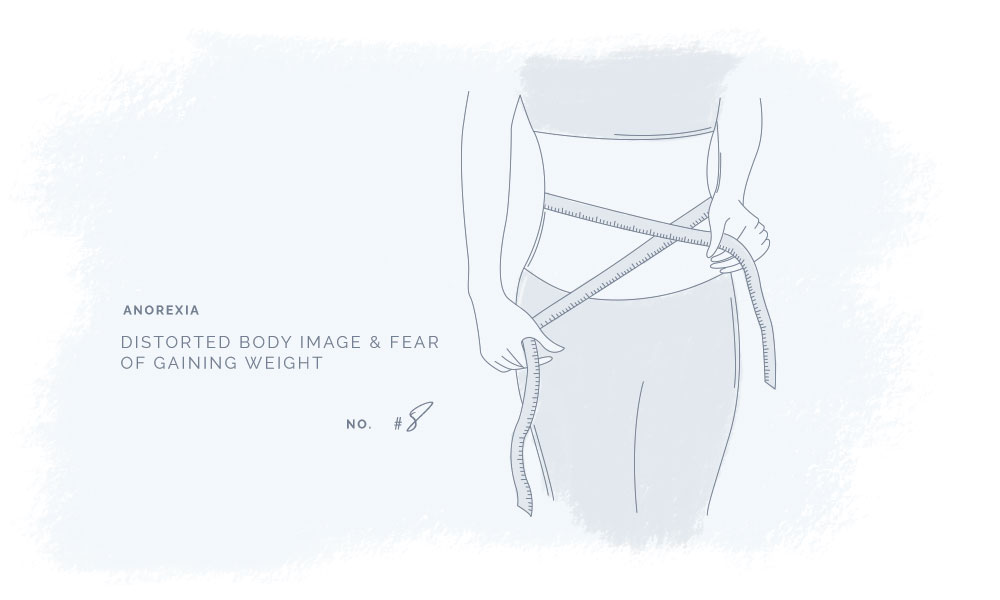
Anorexia nervosa (commonly referred to just as anorexia) is a serious psychological- and eating disorder that leads to a distorted perception of body image, abnormally low body weight, and an intense fear of gaining weight.
The disorder interferes with most aspects of life as people who are suffering from anorexia often will take extreme actions to control their body weight.
Symptoms
The signs and symptoms of anorexia can be both physical and emotional/behavioral.
Physical symptoms may include:
- Extreme weight loss
- Fatigue
- Insomnia
- Fainting
- Absence of menstruation
Emotional/behavioral symptoms may include:
- Highly restrictive food consumption
- Extreme exercise
- Depression
- Lack of sexual interest
Cause
Up to this date, the exact cause of anorexia is not yet known. However, it is suggested that a combination of biological, psychological, and environmental factors can play a role in the development of anorexia.
Anorexia Symptoms
Distorted body image leading to physical symptoms such as extreme weight loss and emotional restrictive diet and psychiatric disorders.
Therapeutic Potential
Preclinical data suggests CBG and THC among other cannabinoids may be therapeutic for Anorexia.
Application options
Depending on your needs, the optimal type of application may vary. Find more information on our application options.
The connection between Cannabinoids & Anorexia
Studies find that CBD and THC may have great therapeutic potential and may be used to help treat Anorexia. CBD and THC are well-known cannabinoids, however, they do not have the same psychoactive effects. THC is psychoactive while CBD does not possess psychoactive effects. According to WHO guidelines, the cannabidiol CBD is generally well tolerated with a good safety profile.
Preclinical and clinical data suggest that the cannabinoid THC is a potent appetite stimulator that may be beneficial in the treatment of anorexia.
In a pilot study, patients with anorexia nervosa reported that low doses of oral THC produced positive effects, including improvements in self-reported body care and depression.
Literature Discussion
The literature discussion is an overview of the published results from scientific studies investigating if and how cannabinoids can be beneficial in the treatment of Anorexia. The overview will be updated regularly to ensure the newest and most accurate information.
CB1 and FAAH show a significant connection to anorexia and bulimia
Patients with anorexia have elevated levels of CB1 receptors in brains. Similarly, bulimia patients were also shown to have elevated levels of CB1 receptors in some brain regions.
It was demonstrated that mutations in CB1 and FAAH (the major endocannabinoid degrading enzyme) are connected to anorexia and bulimia.
Food intake influenced by 2AG, AEA and CBG
2AG and anandamide play a role in controlling food intake.
Hyperphagia (excessive or extreme hunger) caused by CBG in animals does not produce negative neuromotor side effects.
Likewise, CBG-BDS can help stimulate appetite, probably via CB1.
Clinical Trials
Clinical trials are research studies that examine new treatments and evaluate their effects on human health outcomes.
Synthetic THC cause small but significant weight gain
A randomized controlled trial aimed to assess the effect of dronabinol (a synthetic form of THC) on body weight in women with anorexia nervosa. It was found that dronabinol treatment produced a positive effect, causing a small but significant weight gain in anorexic women.
Cannabinoids & Receptors
Below you find the plant cannabinoids, cannabinoid receptors, and endocannabinoids that are associated with the potential therapy.
CBD
Cannabidiol (CBD) is a dominant cannabinoid in hemp. CBD does not possess psychoactive effects and does not make people high. CBD has been demonstrated to have potential as an alternative for several health-related conditions, including anxiety, pain, depression, among others.
THC
Tetrahydrocannabinol (THC) is a cannabinoid found in the cannabis plant. THC possesses psychoactive properties.
CB2
Cannabinoid receptors are located on the surface of cells in your body and they “listen” to conditions outside the cell. CB2 receptors are key players in the ECS. CB2 receptors are more abundant outside the nervous system, including cells of the immune system.
If you have any further information relevant to the connection between Anorexia and cannabinoids or find any of the information inaccurate, outdated or incomplete please contact us here
References
- https://www.mayoclinic.org/diseases-conditions/anorexia-nervosa/symptoms-causes/syc-20353591
- https://ghmedical.com/endocannabinoid-system/diseases/anorexia
- Avraham, Y. (2017). ” The Impact of Δ9-THC on the Psychological Symptoms of Anorexia Nervosa: A Pilot Study”. https://pubmed.ncbi.nlm.nih.gov/29735812/
- Gérard, N., Et al. (2011). ”Brain type 1 cannabinoidreceptor availability in patients with anorexia and bulimia” Biol. Psychiatry 70, 777–784. https://pubmed.ncbi.nlm.nih.gov/21718968/
- Monteleone, P., Et al. (2009). Association of CNR1 and FAAH endocannabinoidgene polymorphisms with anorexia nervosa and bulimia nervosa: evidence for synergistic effects. Genes Brain Behav. 8, 728–732. https://onlinelibrary.wiley.com/doi/full/10.1111/j.1601-183X.2009.00518.x
- Fride, E., Et al. (2005). ”endocannabinoids and food intake: newborn suckling and appetite regulation in adulthood. Experimental Biology and Medicine (Maywood, N.J.), 230(4), 225-234. https://pubmed.ncbi.nlm.nih.gov/15792943/
- Brierley, D. I., Et al. (2017). A cannabigerol-rich Cannabis sativa extract, devoid of [INCREMENT]9-tetrahydrocannabinol, elicits hyperphagia in rats. Behavioural Pharmacology. https://doi.org/10.1097/FBP.0000000000000285
- Brierley, D. I., Et al. (2016). Cannabigerol is a novel, well-tolerated appetite stimulant in pre-satiated rats. Psychopharmacology, 233(19-20), 3603-3613. https://doi.org/10.1007/s00213-016-4397-4
- Andries, A., Et al. (2014). Dronabinol in severe, enduring anorexianervosa: a randomized controlled trial. Int. J. Eat. Disord. 47, 18–23. https://onlinelibrary.wiley.com/doi/abs/10.1002/eat.22173