
Morphine Interaction
Behavioral, Neurodevelopmental, Psychiatric
What is Morphine Interaction
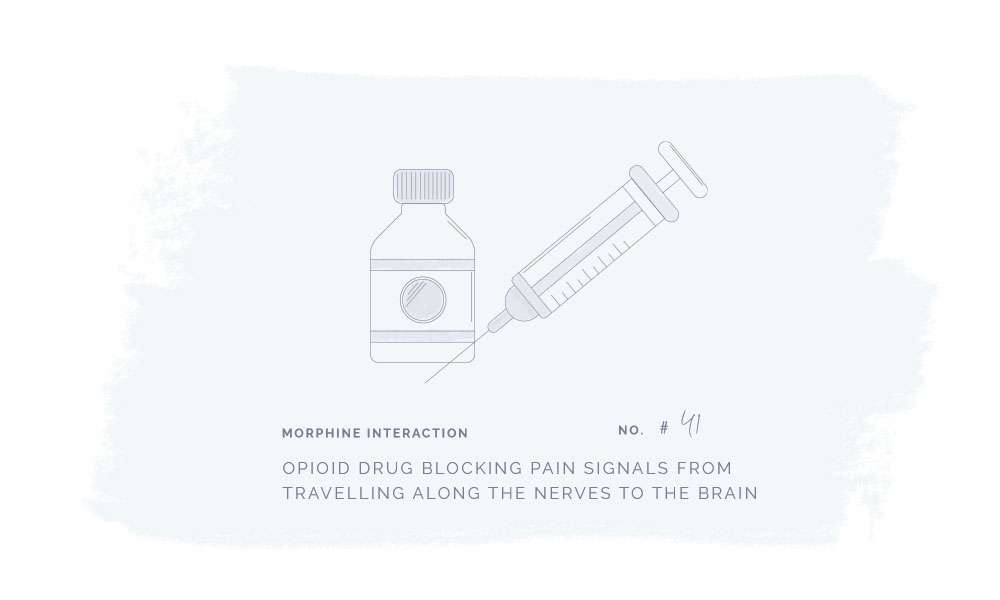
Morphine is an opioid drug used as a strong painkiller to treat severe pain by blocking pain signals from traveling along the nerves to the brain. Morphine can be used for acute pain after an operation, injury, or pain associated with diseases such as cancer or heart attack as well as for persistent pain.
Symptoms
Morphine intake may in some cases lead to an addiction. In addition, alcohol consumption can increase the risk for the most common side effects of morphine which include:
- Purging
- Sleepiness
- Constipation
- Confusion
- Dizziness
- Headache
- Itchiness or rash
Even though morphine is suitable for both adults and children, morphine may not be given to people who have one of the following conditions, diseases, or disorders:
- In general, not recommended during pregnancy
- Previous allergic reaction to other medicines
- Lung diseases
- Diseases causing seizures
- Head injuries
- Untreated thyroid diseases
- Adrenal gland diseases
- Kidney or liver diseases
- Enlarged prostate condition
- Low blood pressure
- Myasthenia gravis
Cause
Morphine is an opioid drug that works by interacting with opioid receptors in the brain, spinal cord, and other areas of the body, leading to reduced pain.
Morphine Interaction Symptoms
Purging, sleepiness, constipation, confusion, dizziness, and headache among others.
Therapeutic Potential
Preclinical data suggests CBD and THC among other cannabinoids may be therapeutic for Morphine Interaction.
Application options
Depending on your needs, the optimal type of application may vary. Find more information on our application options.
The connection between Cannabinoids & Morphine Interaction
Studies find that CBD and THC may have great therapeutic potential and may be used to help treat Morphine Interaction. CBD and THC are well-known cannabinoids, however, they do not have the same psychoactive effects. THC is psychoactive while CBD does not possess psychoactive effects. According to WHO guidelines, the cannabidiol CBD is generally well tolerated with a good safety profile.
It was suggested that a combination of morphine with cannabinoids may exhibit a synergistic interaction effect in treating some types of pain. Low doses of both morphine and cannabinoids also decrease the risk of tolerance being developed to the drugs.
Literature Discussion
The literature discussion is an overview of the published results from scientific studies investigating if and how cannabinoids can be beneficial in the treatment of Morphine Interaction. The overview will be updated regularly to ensure the newest and most accurate information.
THC may influence morphine interaction
In animal models, morphine potency was found to be increased when combined with THC.
Also, it was also shown that tolerance can be avoided when combining low doses of morphine and THC.
Only in the acetic acid-stimulated stretching assay, CBD was found to exhibit a synergistic effect with morphine.
Clinical Trials
Clinical trials are research studies that examine new treatments and evaluate their effects on human health outcomes.
THC and Morphine may exhibit a synergistic effect
It was shown that a combination of THC and morphine can produce some analgesic effects, but more studies are needed.
In the affective component of pain, THC was found to exhibit a synergistic effect when combined with morphine.
Cannabinoids & Receptors
Below you find the plant cannabinoids, cannabinoid receptors, and endocannabinoids that are associated with the potential therapy.
CBD
Cannabidiol (CBD) is a dominant cannabinoid in hemp. CBD does not possess psychoactive effects and does not make people high. CBD has been demonstrated to have potential as an alternative for several health-related conditions, including anxiety, pain, depression, among others.
THC
Tetrahydrocannabinol (THC) is a cannabinoid found in the cannabis plant. THC possesses psychoactive properties.
CB2
Cannabinoid receptors are located on the surface of cells in your body and they “listen” to conditions outside the cell. CB2 receptors are key players in the ECS. CB2 receptors are more abundant outside the nervous system, including cells of the immune system.
If you have any further information relevant to the connection between Morphine Interaction and cannabinoids or find any of the information inaccurate, outdated or incomplete please contact us here
References
- https://www.nhs.uk/medicines/morphine/
- https://www.webmd.com/pain-management/guide/narcotic-pain-medications#1
- https://ghmedical.com/endocannabinoid-system/diseases/morphine-interaction
- Smith, F.L., Et Al., (1998). ”The enhancement of morphine antinociception in mice by delta9-tetrahydrocannabinol”. https://pubmed.ncbi.nlm.nih.gov/9632241/
- Tham, S.M., Et Al., (2004). ” Synergistic and additive interactions of the cannabinoid agonist CP55,940 with μ opioid receptor and α2-adrenoceptor agonists in acute pain models in mice”. https://www.ncbi.nlm.nih.gov/pmc/articles/PMC1576059/
- Cichewicz, D.L., McCarthy, E.A., (2003). “Antinociceptive synergy between delta(9)-tetrahydrocannabinol and opioids after oral administration”. https://pubmed.ncbi.nlm.nih.gov/12604676/
- Smith, P.A., Et Al., (2007). ” Low dose combination of morphine and Δ9-tetrahydrocannabinol circumvents antinociceptive tolerance and apparent desensitization of receptors”. https://www.ncbi.nlm.nih.gov/pmc/articles/PMC2040345/
- Neelakantan, H., Et Al., (2015). “Distinct interactions of cannabidiol and morphine in three nociceptive behavioral models in mice”. https://pubmed.ncbi.nlm.nih.gov/25485642/
- Naef, M., Et Al., (2003). “ The analgesic effect of oral delta-9-tetrahydrocannabinol (THC), morphine, and a THC-morphine combination in healthy subjects under experimental pain conditions”. https://vbn.aau.dk/en/publications/the-analgesic-effect-of-oral-delta-9-tetrahydrocannabinol-thc-mor
- Roberts, J.D., Et Al., (2006). ” Synergistic affective analgesic interaction between delta-9-tetrahydrocannabinol and morphine”. https://pubmed.ncbi.nlm.nih.gov/16375890/