
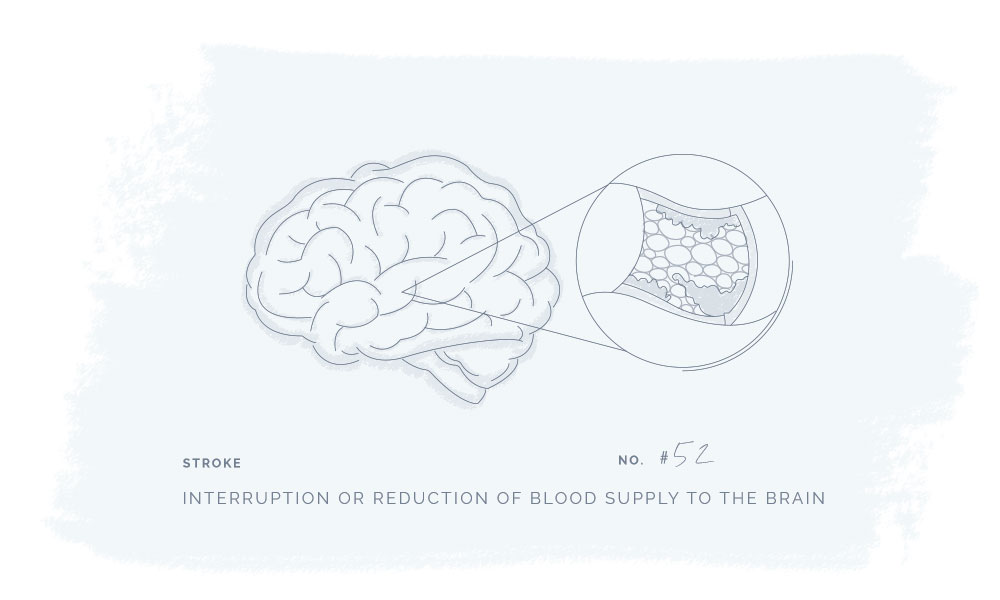
Stroke
Neurodevelopmental
What is Stroke
A stroke is a serious medical condition that happens when the blood supply to some part of the brain is abruptly interrupted or decreased, leading to sudden death (within minutes) of brain cells.
Symptoms
- Difficulty speaking, communication, and understanding other people
- Sudden paralysis, numbness, or weakness in the face, arm, or leg
- Eye problem(s) e.g. blurred-, blackened- or double vision
- Sudden and severe headache, that may be accompanied by purging, dizziness, or distorted consciousness
- Difficulty walking e.g. lack of balance or stumbling
It is important to be aware of when the first symptoms of stroke occur because the treatment success depends on how fast patients get help.
Cause
There are several types of strokes with ischemic stroke being the most common.
- Ischemic stroke
This occurs when the brain´s blood vessels are narrowed or blocked, leading to decreased blood flow. - Hemorrhagic stroke
This occurs when a blood vessel in the brain leaks or bursts.
Stroke Symptoms
Sudden paralysis of the face, arm leg, and difficulty speaking, communicating, and understanding other people.
Therapeutic Potential
Preclinical data suggests CBD and THC among other cannabinoids may be therapeutic for Stroke.
Application options
Depending on your needs, the optimal type of application may vary. Find more information on our application options.
The connection between Cannabinoids & Stroke
Studies find that CBD and THC may have great therapeutic potential and may be used to help treat stroke. CBD and THC are well-known cannabinoids, however, they do not have the same psychoactive effects. THC is psychoactive while CBD does not possess psychoactive effects. According to WHO guidelines, the cannabidiol CBD is generally well tolerated with a good safety profile.
Clinical research proposes that the cannabinoids THC and CBD may be helpful in the treatment of stroke as these cannabinoids have been found to exhibit neuroprotective effects. It was shown that cannabinoids can help limit excitotoxicity, oxidative stress and neuroinflammation, suggesting that they may represent a good pathway when developing future treatments.
Literature Discussion
The literature discussion is an overview of the published results from scientific studies investigating if and how cannabinoids can be beneficial in the treatment of stroke. The overview will be updated regularly to ensure the newest and most accurate information.
Today, we are not able to provide any literature discussion about cannabinoids and stroke.
Clinical Trials
Clinical trials are research studies that examine new treatments and evaluate their effects on human health outcomes.
Endo-, Plant- and cannabinoid receptors may be involved in reducing neuronal degeneration after a stroke
Meta-analysis disclosed that neuronal degeneration can be reduced by endocannabinoids such as AEA, OEA, or PEA and plant cannabinoids such as THC and CBD after stroke.
The strongest protective effect was through activation of CB1 and/or CB2 but other receptors like 5-HT1A and PPARα are also likely to play a role.
Cannabinoids & Receptors
Below you find the plant cannabinoids, cannabinoid receptors, and endocannabinoids that are associated with the potential therapy.
CBD
Cannabidiol (CBD) is a dominant cannabinoid in hemp. CBD does not possess psychoactive effects and does not make people high. CBD has been demonstrated to have potential as an alternative for several health-related conditions, including anxiety, pain, depression, among others.
THC
Tetrahydrocannabinol (THC) is a cannabinoid found in the cannabis plant. THC possesses psychoactive properties.
CB2
Cannabinoid receptors are located on the surface of cells in your body and they “listen” to conditions outside the cell. CB2 receptors are key players in the ECS. CB2 receptors are more abundant outside the nervous system, including cells of the immune system.
If you have any further information relevant to the connection between Stroke and cannabinoids or find any of the information inaccurate, outdated or incomplete please contact us here
References
- https://www.mayoclinic.org/diseases-conditions/stroke/symptoms-causes/syc-20350113
- https://ghmedical.com/endocannabinoid-system/diseases/stroke
- Choi, S.H., Et Al., (2019). ”Cannabis and Cannabinoid Biology in Stroke: Controversies, Risks, and Promises”. https://www.researchgate.net/publication/334894928_Cannabis_and_Cannabinoid_Biology_in_Stroke_Contro
- England, T.J., Et Al., (2014). “Cannabinoids in experimental stroke: a systematic review and meta-analysis”. https://pubmed.ncbi.nlm.nih.gov/25492113/