
Cystitis
Autoimmune, Inflammatory
What is Cystitis
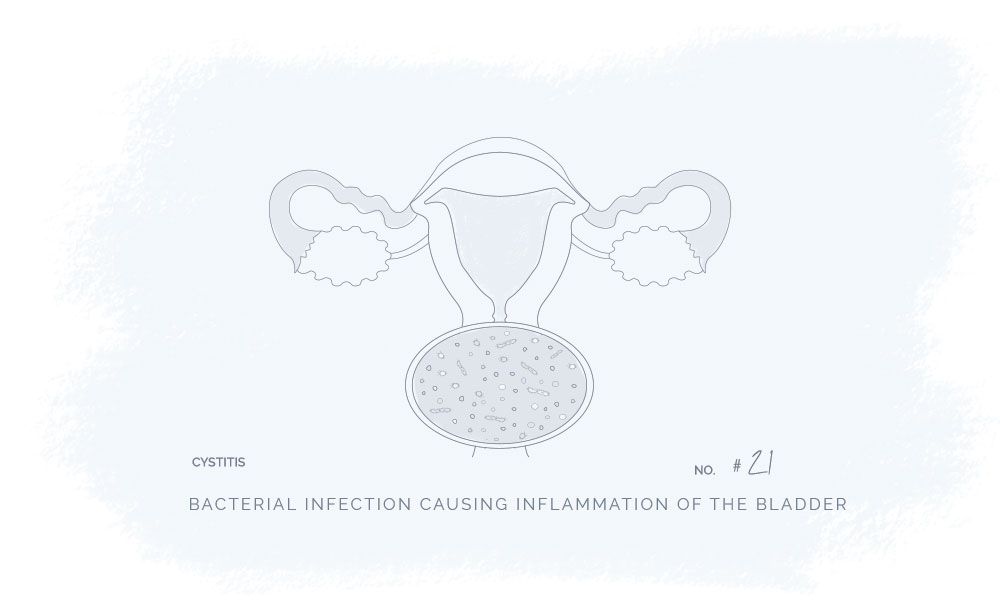
Cystitis is a medical condition described by inflammation of the bladder caused by a bacterial infection (often known as a urinary tract infection). Cystitis can be very painful, and the infection can spread to the kidneys if medical attention and treatment are not provided.
The urinary system consists of the kidneys, ureters, bladder, and urethra, and all are involved in removing waste from the body. The kidneys play a role in filtering waste from the blood and controlling the concentrations of many substances, while ureters are involved in carrying urine from the kidneys to the bladder.
Symptoms
- A persistent, more frequent, and increased urge to urinate
- A burning feeling during urinating
- Blood in the urine (hematuria)
- Strong-smelling and cloudy urine
- Pelvic discomfort and pressure in the lower abdomen
Bacterial cystitis (UTI)
Urinary tract infections primarily happen when outer bacteria enter the urinary tract through the urethra and start to multiply. In most cases of cystitis, E.coli bacteria can cause this infection. However, in women, cystitis can be caused by sexual intercourse or due to the genital area harboring bacteria.
Non-infectious cystitis
If cystitis is not caused by a bacterial infection, other non-infectious factors may play a role in the development of cystitis:
- Interstitial cystitis
Chronic inflammation of the bladder - Drug triggered cystitis
Particular medications may cause inflammation of the bladder - Chemical triggered cystitis
Hypersensitivity to chemicals in products in e.g. hygiene sprays - Radiation cystitis
Inflammatory changes in bladder tissues caused by radiation treatment of the pelvic area - Foreign-body cystitis
Long-term use of a catheter may increase the risk of bacterial infection and tissue damage - Cystitis may develop as a complication of other disorders
Cystitis Symptoms
Increased urge to urinate, burning, strong-smelling and/or blood in urine, and pelvic discomfort.
Therapeutic Potential
Preclinical data suggests CBG among cannabinoid receptors may be therapeutic for Cystitis.
Application options
Depending on your needs, the optimal type of application may vary. Find more information on our application options.
The connection between Cannabinoids & Cystitis
Studies find that CBD and THC may have great therapeutic potential and may be used to help treat Cystitis. CBD and THC are well-known cannabinoids, however, they do not have the same psychoactive effects. THC is psychoactive while CBD does not possess psychoactive effects. According to WHO guidelines, the cannabidiol CBD is generally well tolerated with a good safety profile.
The cannabinoid receptors CB1 , CB2 , TRPV1, and PPARa ‘] are expressed in the bladder and other tissues of the urinary tract, suggesting therapeutic potential with cannabinoids in the treatment of cystitis.
Literature Discussion
The literature discussion is an overview of the published results from scientific studies investigating if and how cannabinoids can be beneficial in the treatment of Cystitis. The overview will be updated regularly to ensure the newest and most accurate information.
Anandamide, TRPV1 and FAAH may be beneficial in treatment
In a rat study, bladder inflammation pain was shown to be induced by anandamide via TRPV1. This proposes that TRPV1 may be used as a therapeutic target.
On the contrary, by increasing the level of anandamide through inhibiting its breakdown by FAAH , potent analgesic and anti-inflammatory effects have been observed.
Cannabinoid receptor CB2 stimulation may be linked to relief of symptoms
In a study with female rats, upon induction of cystitis with cyclophosphamide , an increase was found in PEA and CB1, PPARα was decreased and CB2 was unaffected. PEA was found to reduce pain and bladder voiding. CB1 and PPARα antagonists blocked this effect.
Several studies observed that CB2 was found to be increased with cystitis and that stimulation of CB2 with PEA or anandamide reduced pain and inflammation.
CBG may be therapeutic in bladder disorders
Acetylcholine -induced contractions in the bladder were shown to be reduced by CBG , proposing a potential effect in treating bladder disorders.
Clinical Trials
Clinical trials are research studies that examine new treatments and evaluate their effects on human health outcomes.
Today, we are not able to provide any clinical trials about cannabinoids and Cystitis.
Cannabinoids & Receptors
Below you find the plant cannabinoids, cannabinoid receptors, and endocannabinoids that are associated with the potential therapy.
CBD
Cannabidiol (CBD) is a dominant cannabinoid in hemp. CBD does not possess psychoactive effects and does not make people high. CBD has been demonstrated to have potential as an alternative for several health-related conditions, including anxiety, pain, depression, among others.
THC
Tetrahydrocannabinol (THC) is a cannabinoid found in the cannabis plant. THC possesses psychoactive properties.
CB2
Cannabinoid receptors are located on the surface of cells in your body and they “listen” to conditions outside the cell. CB2 receptors are key players in the ECS. CB2 receptors are more abundant outside the nervous system, including cells of the immune system.
If you have any further information relevant to the connection between Cystitis and cannabinoids or find any of the information inaccurate, outdated or incomplete please contact us here
References
- https://www.mayoclinic.org/diseases-conditions/cystitis/symptoms-causes/syc-20371306
- https://www.hopkinsmedicine.org/health/wellness-and-prevention/anatomy-of-the-urinary-system
- https://ghmedical.com/endocannabinoid-system/diseases/cystitis
literature - Dinis et al., (2004). ” Anandamide-evoked activation of vanilloid receptor 1 contributes to the development of bladder hyperreflexia and nociceptive transmission to spinal dorsal horn neurons in Cystitis. J. Neurosci. Off. J. Soc. Neurosci. 24, 11253–11263”. https://www.ncbi.nlm.nih.gov/pmc/articles/PMC6730374/
- Wang et al., (2015). ”Attenuation of Cystitis and pain sensation in mice lacking Fatty Acid amide hydrolase. J. Mol. Neurosci. MN 55, 968–976”. https://www.ncbi.nlm.nih.gov/pmc/articles/PMC4355044/
- Pessina et al., (2015). ”Protective Effect of Palmitoylethanolamide in a Rat Model of Cystitis. J. Urol”. https://www.auajournals.org/doi/10.1016/j.juro.2014.11.083
- Merriam, F., Et Al., (2008). ”Cannabinoid receptor 2 is increased in acutely and chronically inflamed bladder of rats”. https://pubmed.ncbi.nlm.nih.gov/18778751/
- Tambaro, S., Et Al., (2014). “Evaluation of selective cannabinoid CB(1) and CB(2) receptor agonists in a mouse model of lipopolysaccharide-induced interstitial cystitis”.https://pubmed.ncbi.nlm.nih.gov/24561047/
- Jaggar et al., (1998). ” The anti-hyperalgesic actions of the cannabinoid Anandamide and the putative CB2 receptor agonist palmitoylethanolamide in visceral and somatic inflammatory pain. pain 76, 189–199”. https://pubmed.ncbi.nlm.nih.gov/9696473/
- Wang et al., (2013). ”Activation of cannabinoid receptor 2 inhibits experimental Cystitis. Am. J. Physiol. Regul. Integr. Comp. Physiol. 304, R846–R853”. https://www.ncbi.nlm.nih.gov/pmc/articles/PMC3652164/
- Wang et al., (2014). ” Treatment with a cannabinoid receptor 2 agonist decreases severity of established Cystitis. J. Urol. 191, 1153–1158”. https://www.ncbi.nlm.nih.gov/pmc/articles/PMC4163202/
- Pagano et al., (2015). ”Effect of Non-psychotropic Plant-derived cannabinoids on Bladder Contractility: Focus on Cannabigerol. Natural Product Communications, 10(6), 1009-1012”. https://journals.sagepub.com/doi/pdf/10.1177/1934578X1501000653