
Eczema
Inflammatory, Skin
What is Eczema
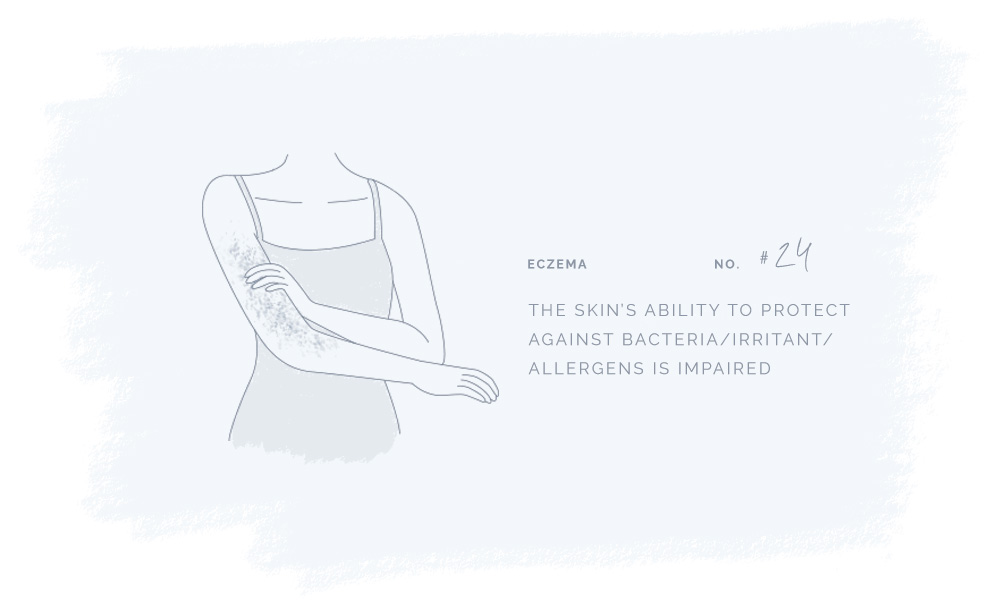
Eczema, also known as atopic dermatitis, is a chronic skin condition associated with a gene variation that impairs the skin´s ability to protect from bacteria, irritants, and allergens.
Symptoms
Eczema varies greatly from individual to individual. In some individuals, eczema appears periodically and then clears up for some time. Commonly, eczema looks like red-, brown- or grayish patches.
The main symptoms of eczema may be:
- Dry skin
- Flaky, thickened, or cracked skin
- Raised small bums that may lead to fluid
- Itchy skin resulting in raw, sensitive, and swollen skin from scratching
Cause
The function of healthy skin is to help retain moisture and shield against bacteria irritants and allergens. Eczema is associated with a gene variation that impairs the affected skin areas’ ability to provide these protections (i.e. against bacteria, irritants, and allergens). The risk factors that may increase the development of eczema are:
- Genetics
- Allergies
- Hay fever
- Asthma
Eczema Symptoms
Dry, thickened, flaky, and cracked skin with small bums that can be itchy leading to raw, sensitive, and swollen skin.
Therapeutic Potential
Preclinical data suggests CBD and THC among other cannabinoids may be therapeutic for Eczema.
Application options
Depending on your needs, the optimal type of application may vary. Find more information on our application options.
The connection between Cannabinoids & Eczema
Studies find that CBD and THC may have great therapeutic potential and may be used to help treat Eczema. CBD and THC are well-known cannabinoids, however, they do not have the same psychoactive effects. THC is psychoactive while CBD does not possess psychoactive effects. According to WHO guidelines, the cannabidiol CBD is generally well tolerated with a good safety profile.
Preclinical evidence proposes that the cannabinoids THC, CBD, THCV , CBDV, and Δ8THC may possess beneficial properties in the treatment of eczema.
Literature Discussion
The literature discussion is an overview of the published results from scientific studies investigating if and how cannabinoids can be beneficial in the treatment of Eczema. The overview will be updated regularly to ensure the newest and most accurate information.
The endocannabinoid system express therapeutic potential in eczema
In a study with mice, it was shown that the levels of endocannabinoid AEA and suspected endocannabinoid PEA were elevated and TRPV1 and PPARa were upregulated. PEA is involved in enhancing the effect of AEA at CB1 , CB2 , and TRPV1 receptors and shielding against keratinocyte inflammation in a TRPV1-, but not CB1, CB2, or PPARα-dependent way.
In mice with Oxazolone-Induced Contact Dermatitis, it was found that the level of 2-AG was elevated, and inflammation was inhibited via CB2 receptors.
In another study with mice, it was shown that inflammation in allergic contact dermatitis was inhibited by CB1 and CB2.
Skin inflammation can be inhibited by THC topical application but in a CB1- and CB2-independent way.
Clinical Trials
Clinical trials are research studies that examine new treatments and evaluate their effects on human health outcomes.
Today, we are not able to provide any clinical trials about cannabinoids and Eczema.
Cannabinoids & Receptors
Below you find the plant cannabinoids, cannabinoid receptors, and endocannabinoids that are associated with the potential therapy.
CBD
Cannabidiol (CBD) is a dominant cannabinoid in hemp. CBD does not possess psychoactive effects and does not make people high. CBD has been demonstrated to have potential as an alternative for several health-related conditions, including anxiety, pain, depression, among others.
THC
Tetrahydrocannabinol (THC) is a cannabinoid found in the cannabis plant. THC possesses psychoactive properties.
CB2
Cannabinoid receptors are located on the surface of cells in your body and they “listen” to conditions outside the cell. CB2 receptors are key players in the ECS. CB2 receptors are more abundant outside the nervous system, including cells of the immune system.
If you have any further information relevant to the connection between Eczema and cannabinoids or find any of the information inaccurate, outdated or incomplete please contact us here
References
- https://www.mayoclinic.org/diseases-conditions/atopic-dermatitis-eczema/symptoms-causes/syc-20353273
- https://ghmedical.com/endocannabinoid-system/diseases/eczema
literature - Petrosino et al., (2010). ” Protective role of palmitoylethanolamide in contact allergic dermatitis. Allergy 65, 698–711”. https://pubmed.ncbi.nlm.nih.gov/19909294/
- Oka et al., (2006). ”Involvement of the cannabinoid CB2 receptor and its endogenous ligand 2-arachidonoylglycerol in oxazolone-induced contact dermatitis in mice. J. Immunol. Baltim. Md 1950 177, 8796–8805”. https://pubmed.ncbi.nlm.nih.gov/17142782/
- Karsak et al., (2007). ” Attenuation of allergic contact dermatitis through the endocannabinoid system. Science 316, 1494–1497”. https://pubmed.ncbi.nlm.nih.gov/17556587/
- Gaffal et al., (2013). ” Anti-inflammatory activity of topical THC in DNFB-mediated mouse allergic contact dermatitis independent of CB1 and CB2 receptors. Allergy 68, 994–1000”. https://pubmed.ncbi.nlm.nih.gov/23889474/